Health & Safety Policy for Business Waste Removal Leyton
 Purpose: This Health and Safety Policy sets out the standards and procedures for our business waste removal operations in the service area. It applies to all staff, contractors and any personnel engaged in commercial or residential rubbish collection, transfer and disposal. The policy aims to protect workers, members of the public and the environment by identifying hazards, reducing risks and ensuring consistent safe work practices across our rubbish removal and waste collection activities.
Scope and Application
All roles involved in waste removal Leyton and associated logistics are covered by this policy, including office staff who coordinate removals, drivers, loaders and site supervisors. Responsibilities include safe vehicle operation, segregation of waste streams, management of sharp or hazardous items and adherence to permit or site-specific rules. The policy supports safe systems of work for both routine and non-routine tasks that may arise within the business waste removal and rubbish collection service area.
 Accountabilities: Senior management hold overall responsibility for policy implementation and ensuring legal compliance. Supervisors are responsible for day-to-day enforcement, inspections and immediate risk control. Employees and subcontractors must follow safe working procedures, report hazards and participate in training. Everyone is expected to demonstrate a proactive approach to safety, highlight unsafe conditions and cooperate in incident investigations to prevent recurrence.
Risk Assessment and Control
A systematic risk assessment process identifies the hazards associated with commercial waste collection, manual handling, vehicle movements, use of plant and machinery, slips, trips and falls, exposure to hazardous substances and interactions with the public. Controls are prioritised following the hierarchy of controls: eliminate, substitute, engineer, administer and use personal protective equipment (PPE) as a last line of defense. Control measures are documented and reviewed when work changes or after an incident.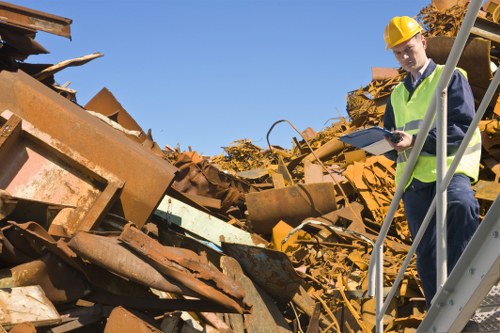 PPE and Equipment: Appropriate PPE such as high-visibility clothing, gloves, steel-toe footwear and eye protection must be issued and used where identified by risk assessment. Equipment including trolleys, lifting aids and vehicle tail lifts should be maintained according to manufacturer guidance and inspected regularly. Safe loading practices, correct use of restraints and secure compaction procedures reduce the risk of shifting loads or flyaway debris during transport.
Training and competence are central to safe rubbish company operations. Induction, job-specific instruction and refresher sessions cover manual handling techniques, hazardous waste recognition, confined space awareness (where applicable), driver safety and emergency procedures. Records of training are maintained and competence assessed before staff undertake higher risk tasks. New processes or equipment require targeted training and supervision until competence is demonstrated.
Operating vehicles within the waste removal service area requires strict adherence to road safety, loading limits and secure communication of routes and potential hazards. Pre-start vehicle checks, secure documentation and correct segregation of waste types during collection and transfer are enforced. The policy emphasises that vehicles must not be overloaded and drivers must comply with rest periods and regulations governing commercial transport to reduce fatigue-related risks.
 Hazardous and Special Waste: Certain items such as asbestos, sharps, chemicals and batteries require specialist handling and may need licensed disposal. When such materials are encountered during routine collections, staff must isolate the items, cordon off the area if necessary and seek direction from the appointed competent person. Clear procedures exist for identification, containment and transfer of hazardous materials to authorised facilities.
 Incident Reporting and Continuous Improvement: All incidents, near misses and safety concerns must be reported promptly. Incident reports trigger investigation, corrective actions and dissemination of lessons learned. Regular audits, toolbox talks and performance reviews monitor compliance and drive improvements. The policy commits to regular review cycles to ensure alignment with evolving best practice in waste management and occupational health and safety.
Emergency preparedness includes clearly documented response plans for spills, fires, vehicle accidents and medical emergencies. Staff are provided with access to emergency equipment, spill kits and first aid facilities as appropriate to their role. Evacuation routes and muster points are communicated to all personnel operating at client sites or transfer facilities to ensure timely response when incidents occur.
Management ensures that monitoring and measurement mechanisms are in place. Key performance indicators may include incident rates, training completion, vehicle inspection compliance and audit outcomes. Corrective and preventive actions are prioritized and resourced. This continuous monitoring supports accountability and demonstrates a commitment to a safer, more reliable rubbish removal and business waste service area.
Policy Review and Commitment: This Health and Safety Policy is reviewed at planned intervals or following significant changes to operations, legislation or after a serious incident. Senior leadership endorses this policy and expects every person involved in waste removal and rubbish collection to work in accordance with it. By maintaining high standards of risk management, training and operational controls, the organisation seeks to protect people, property and the environment while delivering dependable business waste removal services.
